 HUN-REN Biological Research Centre, Szeged



Structural elements of the cytoskeleton are also present in the cell nucleus, where they perform numerous functions. In the case of actin—an ancient cytoskeletal protein found in all eukaryotic cells—it is now known that its nuclear transport is highly dynamic, its nuclear levels are tightly regulated, it functions in both monomeric and polymeric forms, and it participates in fundamental nuclear processes.
One of the main research interests of our group is to investigate the biological significance of nuclear actin. In this context, we have found that the presence of actin in the nucleus is over secured, and accordingly we have identified three importins that may be responsible for transporting actin into the nucleus.
In recent years we have also begun to study the role of nuclear actin in the differentiation of immune cells. For this purpose we use the fruit fly (Drosophila) as a model organism. Our results so far indicate that fly blood cells are sensitive to nuclear actin, and disruption of nuclear actin interferes with their differentiation.

A) The green fluorescent signal in the cells demonstrates the physical interaction between actin and the nuclear importin called Ketel.
B) The nucleus of fruit fly (Drosophila) blood cells (indicated by the arrow) contains actin.
Our research group also investigates the nuclear functions of actin-binding ERM proteins. ERM proteins play essential roles in cell adhesion, cell motility, and intracellular transport processes, and therefore are key regulators of cell polarity, morphogenesis, and tumor metastasis.
By studying the single ERM representative in Drosophila, Moesin, we demonstrated that ERM proteins are also present in the nucleus. We identified the protein motifs and mechanisms regulating the nuclear localization of Moesin, and examined the dynamics and regulation of its nuclear import. We also discovered that, in cooperation with the Mediator complex, Moesin participates in the regulation of heat-shock gene expression as well as in mRNA export.
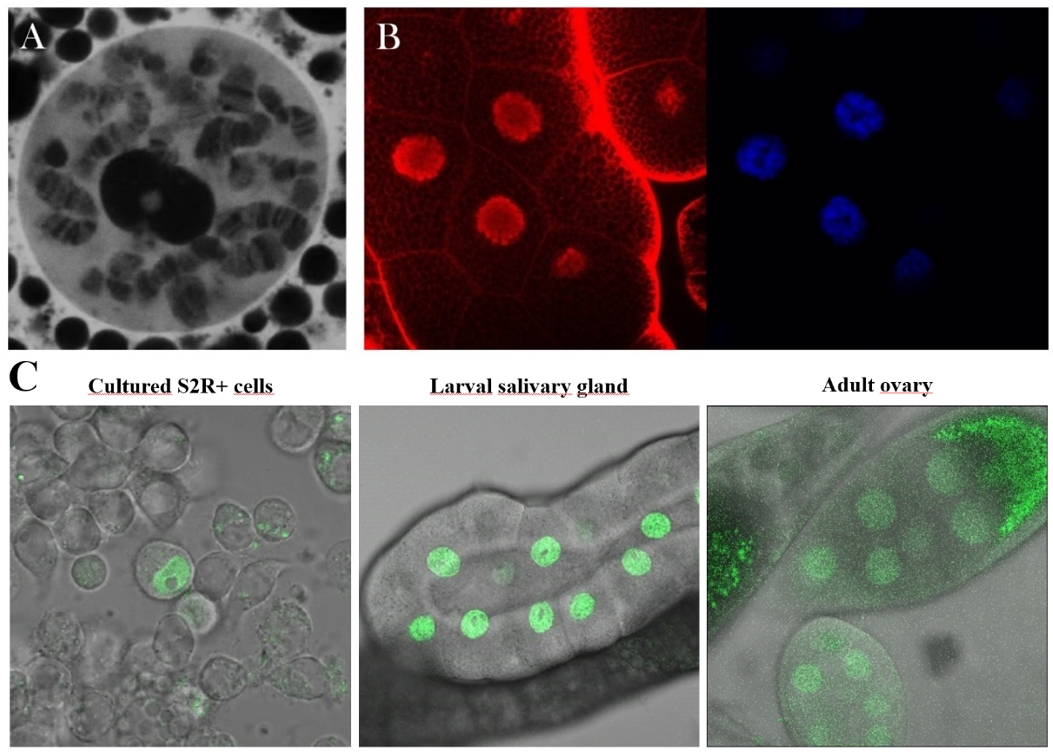
A) The distribution pattern of Moesin (white) in a polytenic, interphase nucleus.
B) The accumulation of Moesin (red) in the nucleus (blue - DAPI).
C) The interaction between Moesin and the mediator complex is indicated by the green fluorescent signal in the nucleus.
Based on these findings, we were able to uncover the complex regulatory system governing the intracellular localization of moesin.
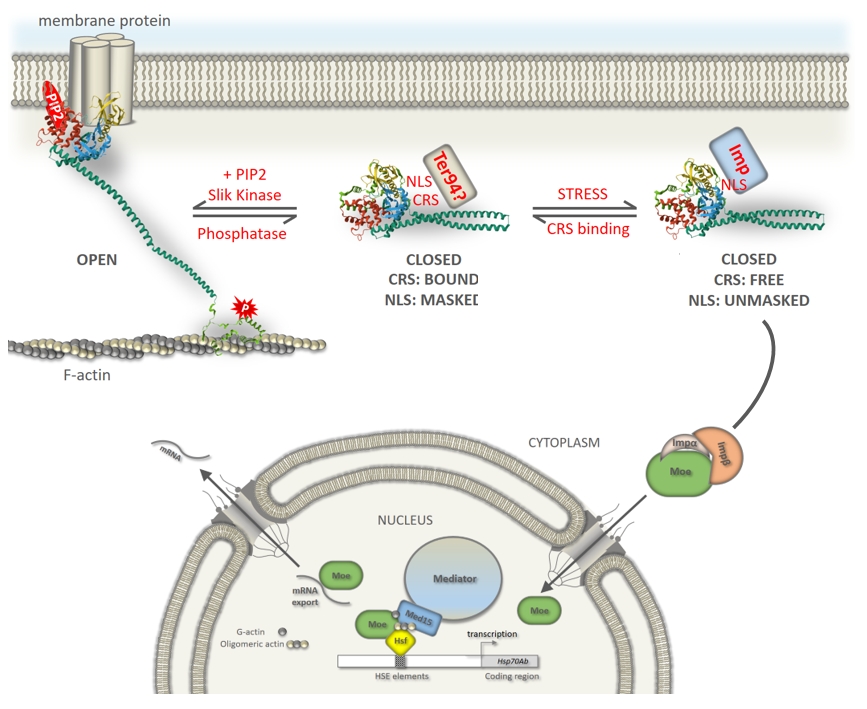
Summary of the transport and function of the cytoskeletal Moesin protein in the cell nucleus.
senior research associate

research associate

research associate

administrator expert
|
Péter, VILMOS
|
senior research associate | publications | CV |
|
Ildikó, KRISTÓ
|
research associate | publications | CV |
|
Anikó, SZABÓ
|
research associate | publications | CV |
|
Csilla, ABONYI
|
administrator expert | publications | CV |
 back
back